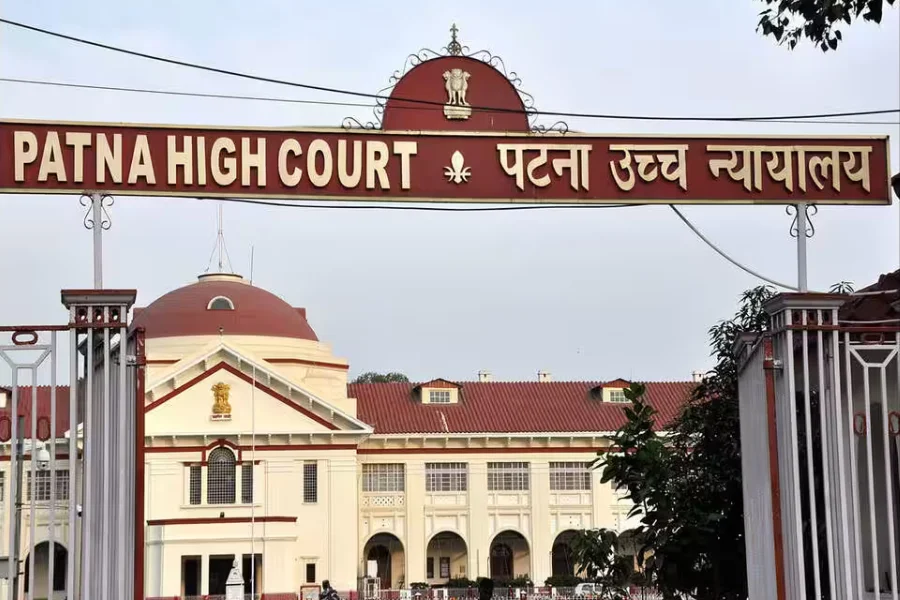
Pressing a Woman’s Mouth and Lying on Her Without Attempted Penetration Does Not Amount to Attempted Rape: Patna High Court
The Patna High Court has partly allowed an appeal filed by Md. Ainul Haque, setting aside his conviction for attempted rape while upholding his conviction for house trespass and finding him guilty of...
The Patna High Court has partly allowed an appeal filed by Md. Ainul Haque, setting aside his conviction for attempted rape while upholding his conviction for house trespass and finding him guilty of assaulting a woman with intent to outrage her modesty. Justice Sandeep Kumar reduced the substantive sentences for both offences to the period already undergone and directed the appellant to pay a fine of ₹25,000, which must be paid entirely to the survivor as compensation.
Court Finds Attempt to Rape Not Established
The case arose from an incident on February 8, 2010, when the complainant, a widow living with her children, alleged that Haque entered her thatched house at around 10 pm, extinguished a lamp, lay on her and pressed her mouth to suppress her cries. Villagers reportedly arrived after hearing her alarm and apprehended him.
The trial court convicted Haque under Sections 376/511 and 448 of the Indian Penal Code (IPC) in July 2013, sentencing him to four years of rigorous imprisonment for attempted rape and six months for house trespass, with the sentences to run concurrently.
Before the High Court, the appellant argued that the prosecution relied primarily on the survivor’s testimony, which contained inconsistencies about whether rape had been committed or attempted. He also pointed to the absence of medical examination, torn clothing, injury marks and testimony from several villagers. The prosecution maintained that the survivor’s account was credible and that a neighbour had corroborated Haque’s presence at the scene.
Justice Kumar held that the evidence established beyond reasonable doubt that Haque had entered the woman’s home at night and was found there when villagers gathered. However, the Court found insufficient evidence to establish the specific acts required to prove attempted rape.
No Evidence of Act Towards Penetration
The Court noted that the survivor’s testimony established that Haque lay upon her and pressed her mouth, but there was no evidence that either person had been undressed, that any clothing had been removed or displaced, or that an overt act towards penetration had occurred.
Relying on Supreme Court precedents, including Aman Kumar v. State of Haryana and Tarkeshwar Sahu v. State of Bihar, the High Court distinguished an assault with sexual intent from an attempt to commit rape. It held that the evidence did not establish that Haque had gone beyond preparation and performed an act towards committing rape.
The Court nevertheless concluded that entering the woman’s home late at night, lying upon her and suppressing her cries amounted to conduct capable of outraging her modesty. It therefore substituted the conviction under Sections 376/511 IPC with one under Section 354 IPC, as applicable before the 2013 amendment.
The conviction under Section 448 IPC for house trespass was affirmed. The Court held that the facts supporting the substituted offence had been put to the appellant during the trial and that no prejudice had been caused by the absence of a separate charge under Section 354.
Age, Delay and Compensation Considered
In deciding the sentence, the Court considered that Haque was around 60 years old, had no criminal antecedents, had spent approximately two and a half months in custody and had remained on bail for more than 13 years without any adverse report concerning misuse of his liberty. The incident had occurred more than 16 years before the judgment.
The Court reduced the substantive sentences for both offences to the period already undergone. However, stressing that the survivor should not be forgotten in the criminal justice process, it imposed a fine of ₹25,000 under Section 354 IPC, directing that the entire amount be paid to her as compensation.
Haque was directed to deposit the amount before the trial court within eight weeks. The court must disburse it to the survivor after due identification. Any fine already deposited under the earlier sentence will be adjusted against the new amount. His bail bonds will stand discharged upon payment; failure to deposit the fine may lead to execution of the default sentence of six months’ simple imprisonment.
Case Details
Case Title: Md. Ainul Haque v. The State of Bihar
Case Number: Criminal Appeal (SJ) No. 579 of 2013; CNR: BRHC010664732013
Judge or Bench: Justice Sandeep Kumar
Decision Date: October 8, 2026